

Greenpointers’ newest series, “Greenpoint at Work,” is taking a deeper look into the lives of people who work in the neighborhood.
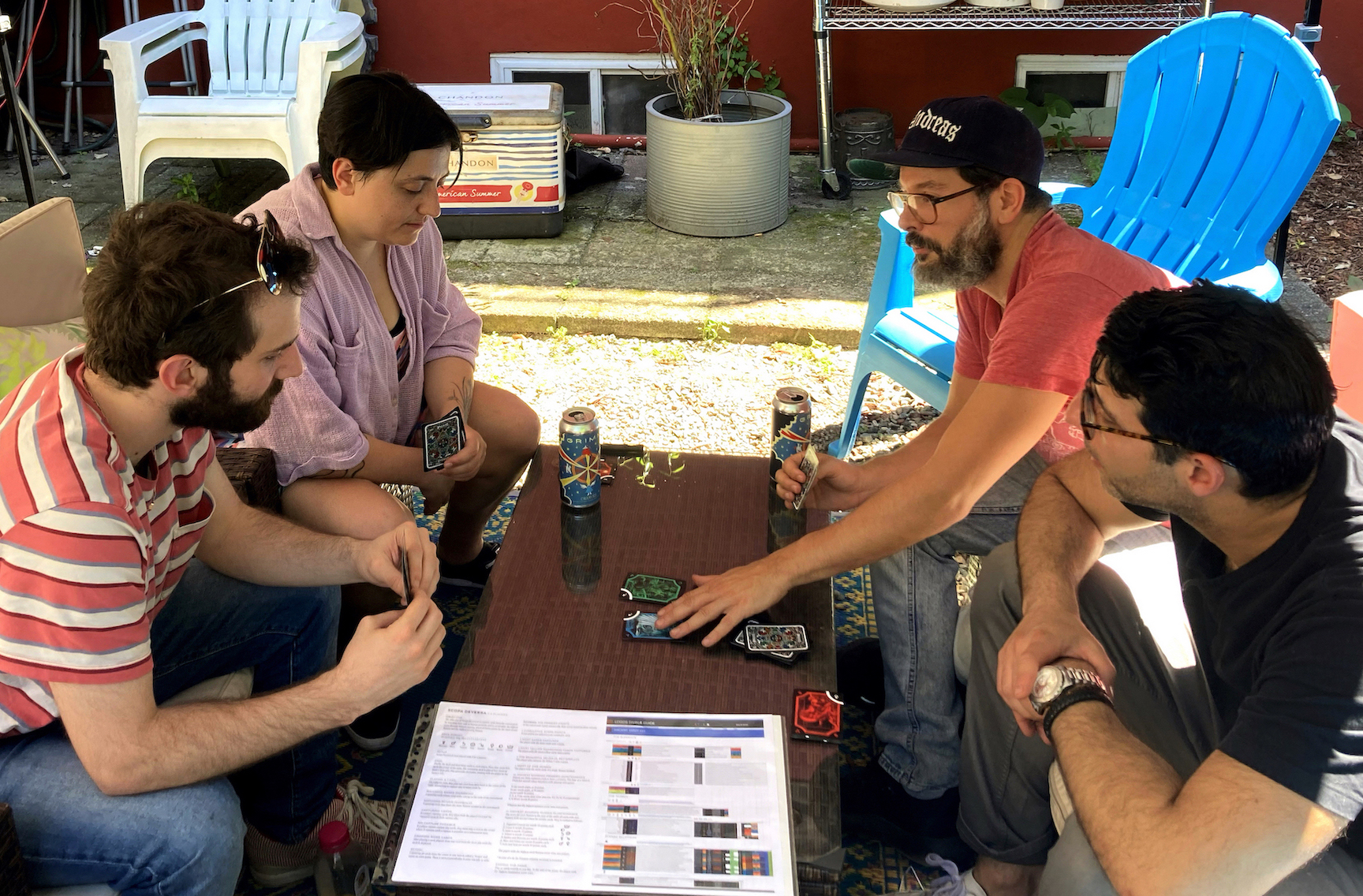
For this week’s edition, we spoke to artist and indie game designer Colin Snyder, who has been living and working in Greenpoint for the past 17 years. In 2019, he founded his studio here called Little Red, where he makes non-fiction games.
When Snyder’s not at Little Red, you’ll find the self-proclaimed pizza lover at The Esters (192 Nassau Ave), where he works a few nights a week.
Learn more about Snyder’s job(s) in our interview below, and check out our last “Greenpoint at Work” profile here.
This interview has been lightly edited for clarity.

Greenpointers: Tell us about your job as an indie game designer.
Colin Snyder: As an indie game designer, I do a bit of everything. I founded my studio, Little Red, in 2019. We handle the entire arc of making and releasing tabletop games: from concept and development, to print production, marketing, and fulfillment. We also design games for clients.
Depending on the stage of the project, I might be deep in research, painting key art and illustrations, designing visual identity and packaging, coordinating with print vendors, testing new games and mechanics, or managing our online retail shop and order fulfillment.
Our first title, LOGOS DIVINÆ, is an ancient prequel to tarot. In the process of making this game, I learned a lot about the history of games, including tarot—and their use not as entertainment, but to reinforce cultural values and beliefs. We wrapped production on two games this year.
Greenpointers: You’ve said that you make “non-fiction” games that focus on “turning systems of knowledge into interactive art.” Can you explain what you mean by this?
Colin Snyder: “Non-fiction games” are teachable systems you can play with. They use the inherent structure of games—like rules and playing cards—to show how a body of knowledge can be navigated.
LOGOS DIVINÆ works as a regular card deck—you can play Rummy with it—its artwork and graphics form a layered system of references, modeling ancient Mediterranean culture and philosophical traditions.
Games create a safe way to learn and interpolate new ideas. Game mechanics have always illuminated the human experience. For instance, Snakes & Ladders began as Moksha Patam, a tool for teaching Hindu philosophy. It’s a game that reinforces the concept of karma and human desire through its mechanics—over time it was adapted to other religions and traditions. These aren’t just spiritual in nature, but ideological, too. Monopoly started as game designer Elizabeth Magie’s polemic critique of land monopolies and wealth extraction.
Non-fiction games offer an approach into subjects that are not easily penetrated or taught. I recently collaborated with a client on a party game that models how cybersecurity risks spread through an organization, and how they can be mitigated. The complexity of the subject emerges through play instead of one’s professional experience, where the stakes are real.

Greenpointers: Well, that sounds cool. How did you get into this line of work?
Colin Snyder: I moved to NYC in 2010 to work on Red Dead Redemption [a video game], and North Brooklyn’s DIY art scene pulled me into Babycastles—an art collective focused on experimental games and installations. With them, I helped build exhibitions in museums and galleries, from handmade arcade cabinets to large-scale interactive environments.
I worked with Ivan Safrin to turn the Hayden Planetarium dome at the American Museum of Natural History into SpaceCruiser, a 200-player game built in a few weeks, and later collaborated with Keita Takahashi, creator of Katamari Damacy, on an arcade at the Museum of Arts and Design.
That period led me to produce a documentary about game design, which opened the door to interviewing designers like Tim Schafer and eventually writing for Vice’s tech vertical, Motherboard. Babycastles’ work ended up touring internationally, including in a traveling exhibition curated by the Victoria & Albert Museum.
Making and publishing experimental games has never been easy, but it shaped everything I do. I draw on my experience as an artist, designer, and writer in my studio practice today—creating games, visual systems, and narrative work for cultural institutions, emerging tech, and client projects alongside independently published releases.
Greenpointers: It sounds like you love what you do. What is your favorite thing about the job?
Colin Snyder: In the past few years, my work has taken me into ancient ruins, museum collections, library stocks, cathedrals and churches around the world. I’ve painted hundreds of images inspired by the work of ancient artisans, and I built a visual system that supports both a new methodology for tarot reading and new ways to play classic card games.
What I value most is seeing the work function in the real world—I’ve done hundreds of tarot readings with LOGOS DIVINÆ, and people are surprisingly direct and reflective in those moments.
This summer, we built a Tarot Room for ChaShaMa’s fundraising gala, and there was a line out the door both nights. Watching the artwork and the system operate in real time—and seeing people find clarity in their own lives from it—makes the years of research and design work feel justified.

Greenpointers: You’ve lived and worked in Greenpoint for 17 years, so you must like it here. Where are your favorite places to go in the neighborhood when you’re not working?
Colin Snyder: In this economy? Even when I’m not working, I’m working. I like making games, but I love pizza. When The Esters opened on Nassau in 2022, I tried one bite and said “I have to work here.” Four years on, I am there a few nights a week, making the best pizzas in the city.
Many of us who work there are independent artists—we make games, art, apparel, jewelry, and ceramics. We are hosting a holiday market at The Esters (192 Nassau Ave) on Monday, December 15, 6 p.m. – 9 p.m. to sell our work if you’d like to support the working artists who live and work in the neighborhood this holiday. Come play some cards, buy some unique gifts, and have a meatball.
Greenpointers: Have you ever thought about making a game set in Greenpoint?
Colin Snyder: I already did! Although it was never finished…I made a game set inside The Palace (206 Nassau Ave.) about a decade ago—it was kind of like if Eugene O’Neill had written Who Framed Roger Rabbit?
From the Mespeatches’ swampland settlements to agrarian flattening, and urban industrialization and subsequent pollution—I’m interested in how the landscape continues to change drastically and the challenges climate change has in store for us as a community. What will life look like in Greenpoint a hundred years from now? I should talk to the Greenpoint History Night crew—maybe there’s an ecological game in there somewhere.
Note: In addition to the holiday market at The Esters on December 15, Snyder will be selling games at Deck the Walls, a holiday market of local artists hosted by The Palace is on December 7 from 2 p.m. – 6 p.m. His games are also available at A Store Called Store and online at www.logos-divinae.com.
Leave a comment