
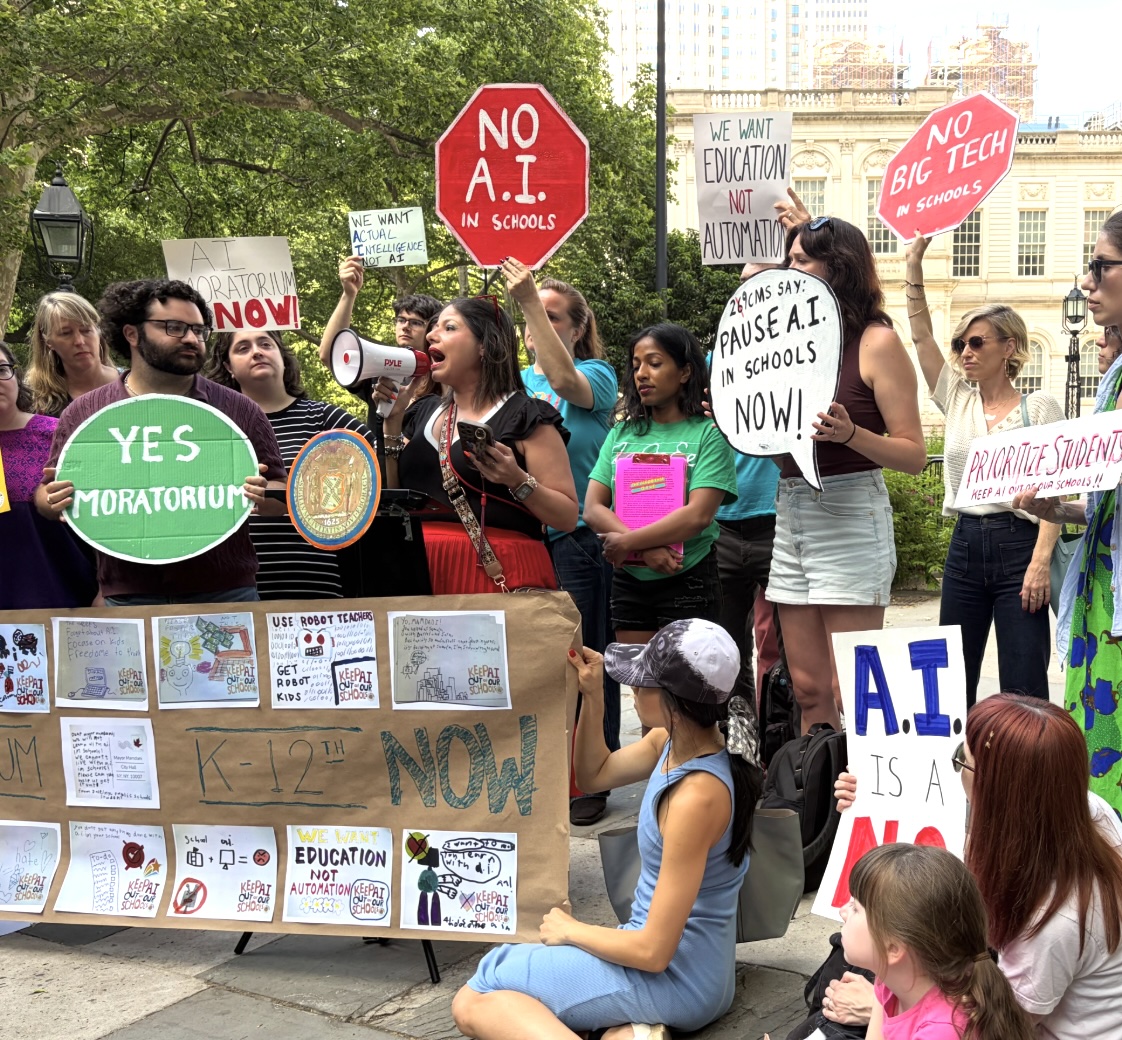

At a time when even adults are glued to their screens, and AI’s encroachment seems poised to radically reshape the labor market, parents say school officials should provide clearer guidelines on the use of technology in their children’s classrooms.
District 14 Families for Intentional Technology Use, a new group consisting of parents from Greenpoint and Williamsburg, recently circulated a petition asking the city’s Department of Education and elected officials for a more thoughtful, evidence-based approach to integrating technology. The petition has garnered 282 public signatories.
The District 14 parents tell Greenpointers that they’re not opposed to technology as a whole, but rather fear the potential safety and developmental implications of tools whose impact is not yet widely understood. Furthermore, they find the technology difficult to navigate and distracting to children’s often limited attention spans.
They’re far from alone. Parents across New York City (rather, across the country) are reckoning with the increased presence of technology in the classroom and decry the lack of transparency from school officials. Chief among concerns are Amira, an AI-based reading app, and i-Ready, a software assessment program most commonly used for math instruction. The use of both varies across different schools, but they’re undoubtedly becoming an outsized force, especially as the COVID-era effectively let the technological toothpaste out of the tube. Intelligencer reports that “since 2024, New York City Schools has implemented [Amira] in around 150 schools across the city.” According to a DOE spokesperson, about 750 New York City schools use products from Curriculum Associates (i-Ready’s parent company).
i-Ready, like Amira, touts a personalized approach that tailors questions to each child. In practice, critics say its methods actually “gamifies” the learning process.
“Students learn very quickly that if they get some questions wrong, then everything gets easier and then they can kind of just click through. And if they get things right, then suddenly it gets kind of hard. And my daughter suddenly got fourth-grade questions in kindergarten,” one District 14 parent told Greenpointers.

i-Ready’s parent company, Curriculum Associates, says that there’s evidence demonstrating the software’s educational benefits. However, i-Ready lacks independently verified studies proving its efficacy.
Parents suspect that DOE officials have embraced the technology less for pedagogical reasons and more for its role in preparing for state tests, which are conducted on computers.
“Maybe leadership likes it because it produces a lot of data and a lot of charts and all of this stuff. But in terms of actually being a tool that guides instruction, I have not heard from any teachers that it’s super useful for that,” said another District 14 parent.
Even worse, the rapid onslaught of the private tech sector into their children’s public school education perhaps offers leadership an opportunity to parlay those connections in the future; one parent compared the relationship to pharmaceutical industry.
“The thing that they really seem to care about is they’re making sure that their own leadership is innovative in some way, and they have this deep FOMO that they’re afraid somehow they’re going to miss out on this great new thing,” said Craig Garrett of the group Families for Human Learning, pointing out that several officials were installed by the scandal-ridden Adams administration.
Regardless of DOE leaders’ possible motivations, there remains an underlying tension of why such a push occurred without the community’s buy-in. Several parents told Greenpointers that they felt like officials brushed off their concerns, especially at district-wide meetings.
“It was really frustrating as a parent to go there with what I feel like our principal concerns around AI and learning and have an official come back with, ‘Sorry, this is a contractual obligation that we’ve already made, so, moving on,’” said Tim Requarth. “That felt to me like an abdication of their responsibility as educators.”
“I want something before it enters the classroom to be proven effective at education. I don’t want it entering the classroom because of vendor lock-in,” he continued.
The debate isn’t only a question of educational methods—parents also have reason to worry about their children’s safety and privacy. Last December, Massachusetts parents brought a class-action lawsuit against Curriculum Associates, alleging improper data collection. Two California parents joined them this month, mounting a suit of their own.
Aside from curriculum data, i-Ready “also collects students’ IP addresses, school name, disability status and eligibility for school lunches,” according to The Guardian. While parents must consent to their children’s use of the program, the suits allege they are not given sufficient information to do so meaningfully (Curriculum Associates denies all claims in the lawsuit). Amira, with its voice-collection technology, also poses similar safety questions.
And it’s not just elementary school students subject to technology’s ever-changing development. The DOE briefly entertained the idea of a selective, AI-focused high school but scrapped the idea after parent pushback this spring.
Almost overnight, AI has wormed its way into our collective consciousness without the proper guardrails, from Google searches to customer service interactions to grocery store prices. The company line, often parroted by corporate firms and educational institutions, boils down to: “AI is here, and you’re going to get left behind if you don’t embrace it.” To Requarth, that logic doesn’t hold much water.
“I think in education, you’re not training people to use a specific set of tools. You’re training them to be able to use any set of tools,” he said. “And so in the same way that you wouldn’t restructure all of education around driver’s ed just because there’s now cars in the world, it doesn’t make any sense to restructure education around AI because there’s AI in the world.”
A few weeks ago, several New York City Council members sent a letter to Mayor Zohran Mamdani and the schools chancellor Kamar Samuels demanding a two-year AI moratorium. The council members called the DOE’s drafted AI guidance “flawed.”
“It contains no proposals to strengthen the privacy and security of the personal student data collected by AI companies, despite the NY State Comptroller’s audit showing that DOE’s current privacy policies and processes are riddled with numerous technical failings and are non-compliant with the NY State Ed Law 2D, the student privacy law,” the letter reads in part, citing at least 100 student data breaches over the past few years.
The area’s city council members, Jennifer Gutiérrez and Lincoln Restler, both signed the letter.
“The prior administration hit the gas on AI without genuine family engagement. That is not the approach Chancellor Samuels will be taking,” a DOE spokesperson said in a statement to Greenpointers. “Earlier this year, New York City Public Schools took the first step to put initial guardrails in place while developing a policy to protect our students in partnership with families and communities. We will be sharing more soon.”
Ultimately, parents want to see an emphasis on the social-emotional aspects of elementary education, with a classroom full of kids reading to each other instead of an iPad.
“It’s about becoming a person, developing an identity for yourself outside of your family for the first time, and also being in a room with other kids who are your age and learning how to do things together and learning about emotional cues and collaborating on things, working together on things,” said Garrett.
“And it just seems like the last place in the world where you want them to be forced to be isolated with screen time for hours every week.”
