
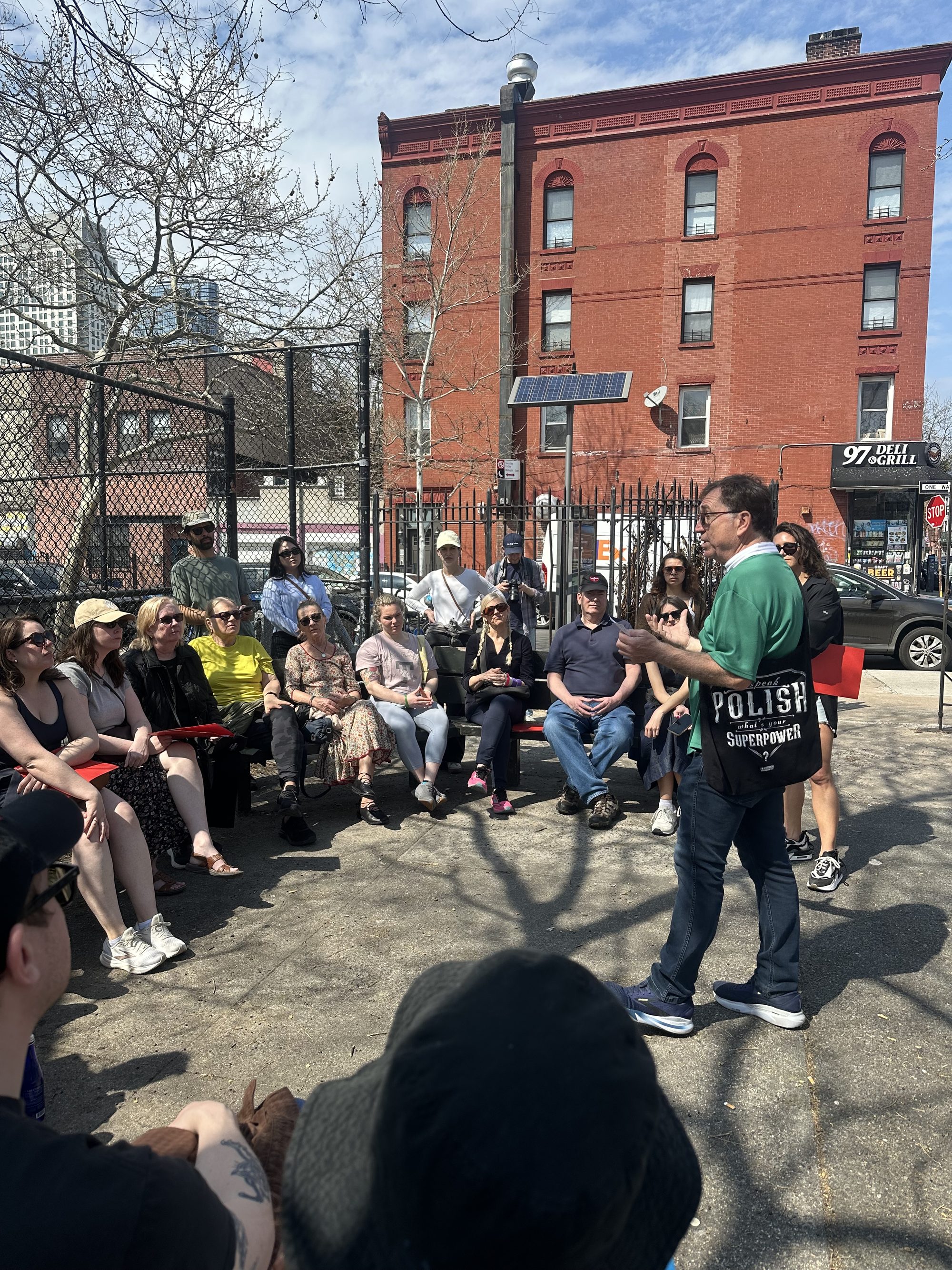
I’m standing in a crowd of 25 people surrounding 118 Milton Street, with our guide who is wearing a “I speak Polish, what is your superpower?” tote bag. He tells us this is the childhood home of Margaret Wise Brown, the woman who wrote Goodnight, Moon. It’s a brick building, with some siding, reminding me of the Greenpoint I knew, whose residents were families that had been in the neighborhood for generations. Having grown up in bordering Williamsburg, I’ve been inside many of these homes, and am struck with the memory of my neighbors who would sit on their stoops in the summer heat, keeping an eye on the block. I often write about my past as a way to metabolize grief and while this act of remembering can be mistaken for dwelling, it’s become my way to carve a path forward.
Geoffrey Cobb, a former high school history teacher, is no stranger to this as he has turned remembering into his calling. A resident of Greenpoint for over a quarter century, he continues to research and preserve the history of the neighborhood, sharing it with others on walking tours that he conducts throughout the year. On this day, the tour is focused on women’s history and he starts by saying, “Without you, there wouldn’t be any of us.” This statement rings true as soon as we meet our first historical woman, Mary Meserole. The daughter of Magdalena Meserole, she followed in her mother’s footsteps marrying a much older man (22 years her senior), Neziah Bliss. He’s considered the founder of Greenpoint, having developed the land, and I wonder if she smirks hearing that as his title, knowing her dowry of 31 waterfront acres was the soil that allowed Greenpoint to grow.
A woman next to me cocoons inside her scarf commenting on the chill that’s reminded us it’s still early spring. When I ask what brought her on the tour, she tells me she’s visiting her daughter who lives here now. I think of Magdalena and Mary, two generations of women repeating cycles dictated by the times, and how sometimes, there ends up being someone in a lineage that overturns the soil. For Greenpoint, that woman was Gussie Freeman.
Many of the warehouses that are now condos and office spaces were formerly rope factories and women were hired due to their lower wage requirements and perceived docility. Gussie uprooted that stereotype. She started working in the factories at age 12 and became known for her brute strength, carrying bales of rope just like the men and displaying a proclivity to fight, never shying away from a boxing match. “Gussie was a powerhouse,” Cobb states, and the other women in the factory knew it too, recruiting her to put a stop to the sexual harassment they faced. She became their protector and Gussie continued to break all the traditional sex roles of the 1800s. It wasn’t without cost, though. A press clipping titled, “She’s The City’s Terror” confirms that her mother was heartbroken by her behavior, as she was often seen smoking cigars and drinking whiskey just like the men of that time. As I learn about Gussie, I think about what change really is and the estrangement from her mother suggests it’s risk, but Gussie’s story shows that the bravest act of all is to try. And sometimes in that trying, the soil ripens. Gussie ended up opening her own bar in Williamsburg, becoming the only female bar owner at the time, and with that, planted the first seed for something new to grow.
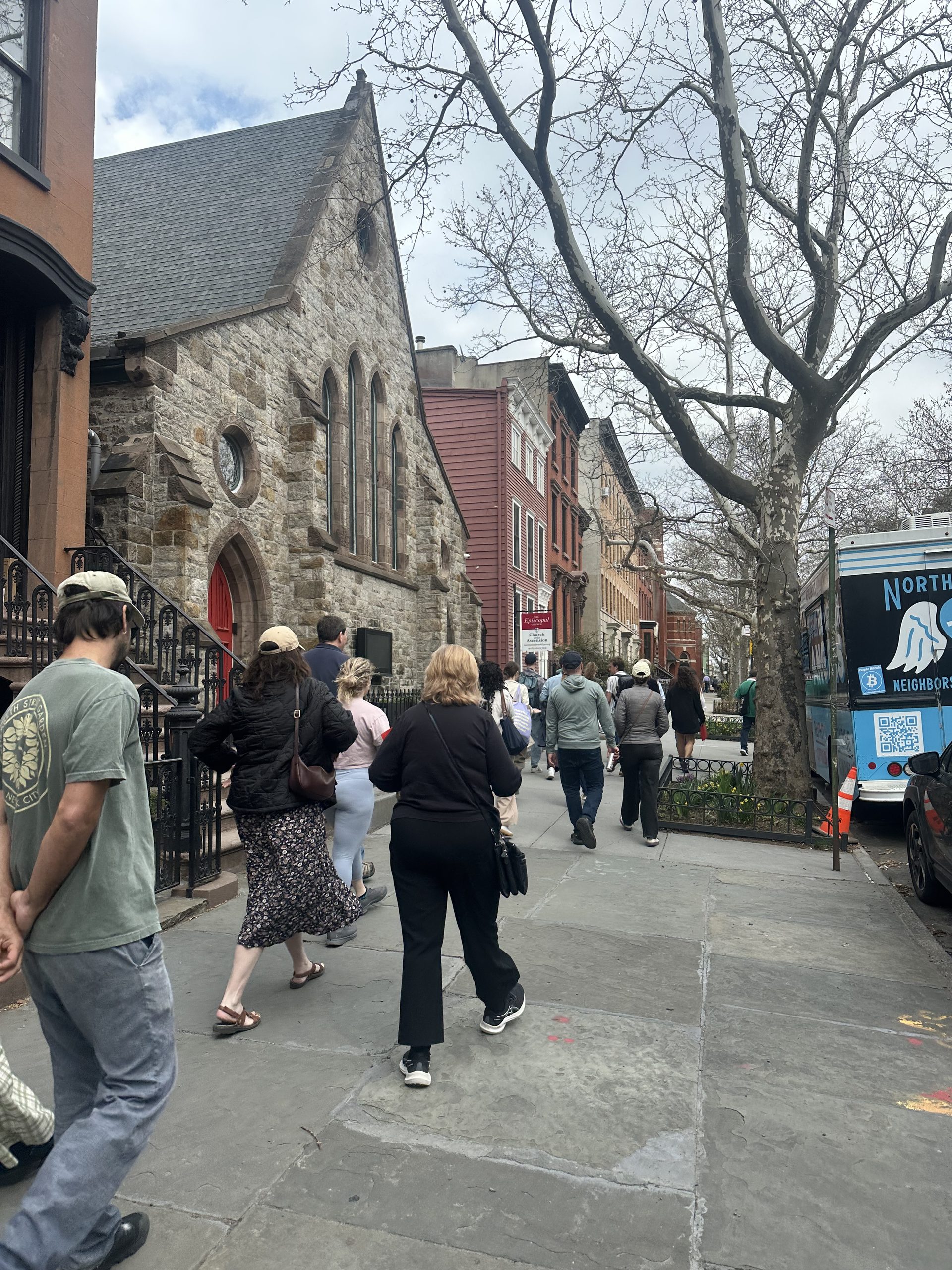
The temperature has dropped and I didn’t bring a jacket. The past few weeks have felt like a constant oscillation between summer and fall, and I’m certain that if Sister Francis Kress were still here, she’d have something to say about that. We learn about her standing on Kent Street in front of Church of the Ascension. She was a Catholic nun and teacher, but also a fierce environmental activist.
A story published in 2017 details her donning a hazmat suit at age 65 to inspect Newtown Creek, the site of one of the country’s largest oil spills. In 1978, after the spill was discovered, she began her investigation. The community urged her to stop, but she never did, and her stubbornness was prophetic. 44 years later, in 2010, it became a designated Superfund site. As we learn more about Kress, Cobb doesn’t shy away from the truth.“There’s always good and bad sides to historical figures,” he says as we learn she would hit her students with a ruler. As I shiver against the cold wind, I wrap my arms around myself and touch the tattoo on my right wrist. It says E Vërtetë, the Albanian word for truth, and Cobb’s statement reminds me that the truth of a person or place is rarely in the extreme, but rather balanced somewhere in the middle.
Next to me on the tour is Julie Won, City Council Member for District 26, currently running for New York’s 7th congressional district. When she finds out I’m a native to Williamsburg she jokes, “I feel like I’m looking at a ghost! One of you exists!” and it’s funny, but true. Like me, many natives of the area have had to move due to the rising rent prices, and it would be easy for me to lament on the negative aspects of that change. In fact, I often do, but it’s not the truth. The influx of new residents has driven the increased development of this area, which has allowed people like my family, Albanian immigrants, to rise out of poverty as the landlords of buildings. I tell Won this, and ask what she thinks that balance is. She emphasizes the importance of listening to the existing community and ensuring they have a voice among the new. Her response reminds me of the start of the tour, standing on West Street, when we learned of Jane Jacobs, the author and activist known for revolutionizing urban planning, who wrote a letter to Bloomberg in 2005, urging him to preserve the waterfront from condos being built. She ended the letter with a simple, but powerful statement, “Come on, do the right thing. The community really does know best.”
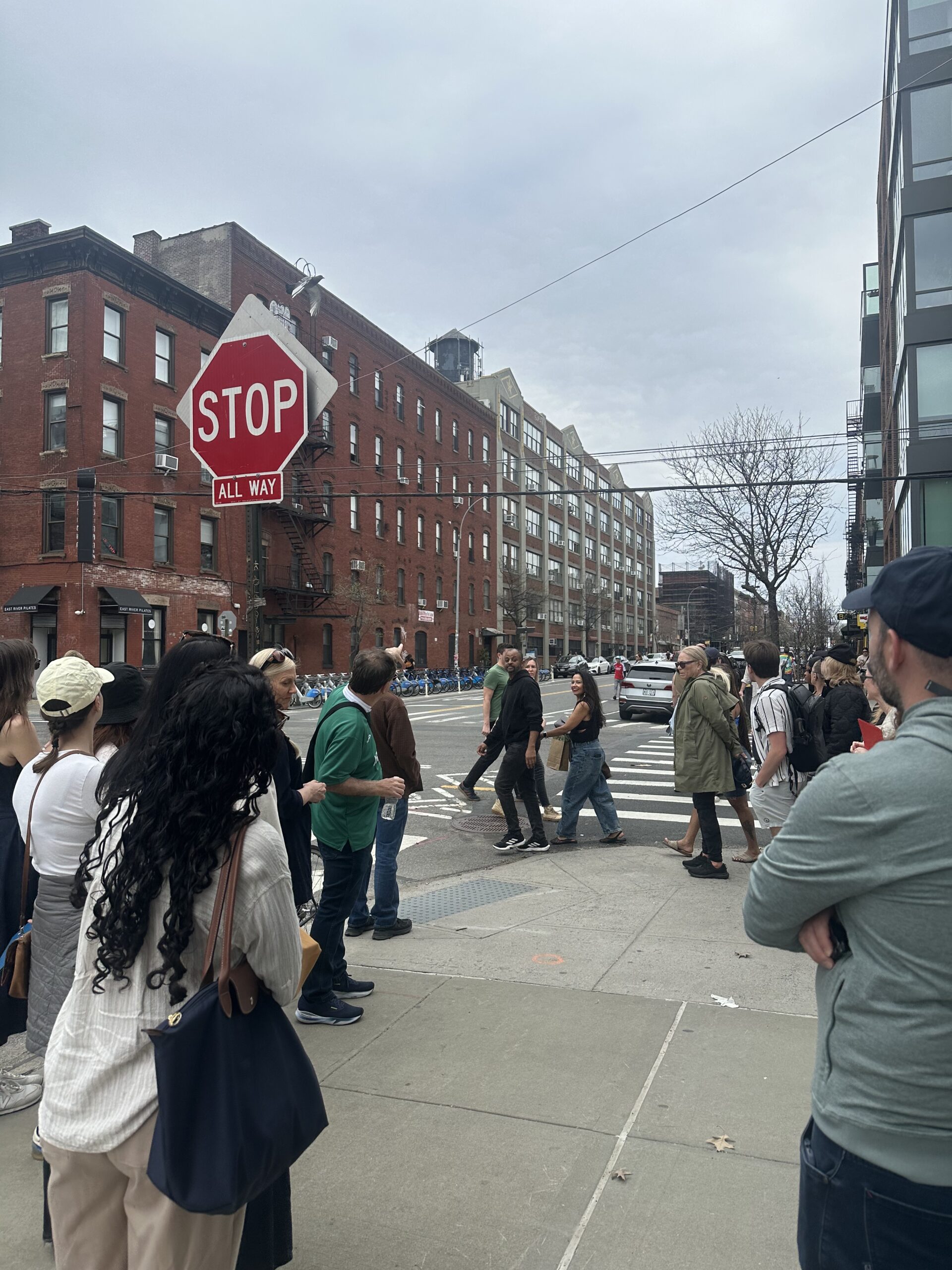
Not all seeds sprout though, and while Jacobs’s letter didn’t result in action from the government, Mae West shows us that the conditions don’t have to be perfect to bloom. It’s unclear whether this famous Brooklynite was born in Greenpoint or Bushwick, but on this tour, Greenpoint claims her as their own. An actress and playwright, she made headlines in 1926 starring in the Broadway play she wrote, produced, and directed called Sex, that was raided and resulted in her arrest due to perceived indecency at the time. While Greenpoint was where it all began for her, she became known for pushing boundaries through her art, and her legacy grew beyond her hometown. As I stand at the end of the tour, on the corner of Oak and Guernsey, I’m moved by Cobb’s dedication to preserving the impact the women of Greenpoint have had on their local community. It strikes me then that the greatest risk is not leaving, but forgetting.
Just like the moon, Greenpoint has gone through many phases, but standing here bracing against the cold with 25 other people, engaging in the radical act of remembering, I understand that is how the garden continues to grow.
Thanks for the kind words. Well written piece