
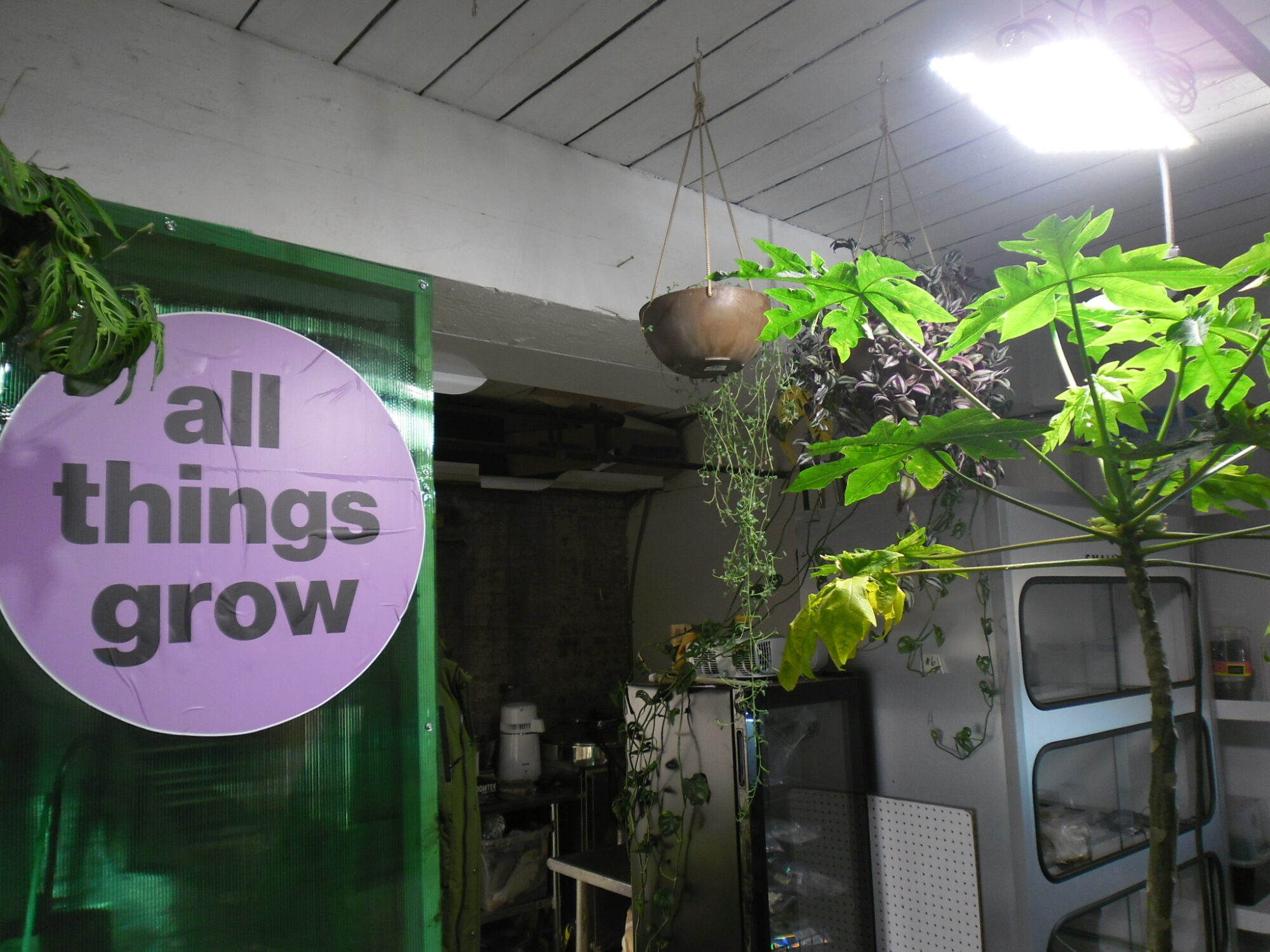

In a studio-sized room on the third floor of 67 West Street, there are no windows and absolutely no sunlight, but the greens of horticultural life are abundant: potted plants crowd a circular table top and hang from the ceiling, bonsai pepper trees line shelves, a small grove of cannabis plants grow under LED lights, and a fruiting papaya tree is the tallest of this indoor forest.
The space is as much a store as it is a living workshop. Cloning experiments are scattered across the room — roots sprouting in water, finding their way through a Ziploc bag of dirt, and steadying a baby fig tree, waiting to be planted after this winter’s last frost. The name of the shop — All Things Grow.
Before settling in at 67 West, All Things Grow was a traveling troupe, selling through pop-ups at local Greenpoint businesses like For the Record (1170 Manhattan Ave.) and Homecoming (116 Franklin St.). Their physical store opened last May, and has been used primarily to teach people general houseplant knowledge, and host classes on cannabis botany, and how to grow their own mushrooms.
“We wanted the space for classes. This is fundamentally a learning space,” said co-founder of All Things Grow, Stu Sherman. “It’s a communal, restorative space for growing, but also sharing that knowledge and experience with people,” he continued, noting how All Things Grow transcends the usual plant shop by offering a portal to understanding plants holistically.

Classes usually start on the right wall of the shop, where there are two large white boards crowded with laminated diagrams, botanical and fungal grow charts, and Sherman’s original color coded “Periodic Table of Nutrients.” The latter is used mainly to direct attention to soil health.
“When people come in, especially if they’ve been growing something in the same soil without any amendments, there might be a nutrient deficiency,” Sherman explained. In the corner, Sherman points to the three tiered worm bucket: another living tool in All Things Grow that helps illustrate how even soil is something to be nourished.
The hand drawn grow charts of cannabis are helpful to introduce students ans customers to the botanical nature of a plant they usually have a different orientation to. Usually taught by Sherman’s co-founder and licensed cannabis cultivator Danny Goldshtein, All Things Grow cannabis classes are coyly called: The science behind the smoke.
“Cannabis is a little tricky because the Office of Cannabis Management (OCM) regulations aren’t fully there yet. You can teach classes and you can grow up to six plants at home…they don’t have real guidance on where to get anything to grow. Other than maybe a loose seed in a bag somewhere,” Sherman said. All Things Grow is attempting to provide that guidance but they do not make, sell, or are involved in the cannabis flower, just the plants and seeds.
For mushroom growing classes, Sherman pulls out a mushroom stuffed animal chain connected by a table of white string to explain the wonders of mycelium.
“When you’re growing mushrooms, people think this is an organism, but the reality is you’re actually growing mycelium and fruiting mushrooms,” Sherman said. Introductory lessons on mycology are followed by the chance to inoculate mushrooms. “Mushrooms are in one way very easy to grow. You don’t water them. You don’t maintain them. You put them in a bag, let the bag sit, and eventually you give it some more oxygen and it fruits,” Sherman said. “The problem is, the growing environment for mushrooms is really good for growing literally everything else, including mold.”
Luckily, All Things Grow has the key to successful inoculation tucked in the corner of the space — a laminar flow hood. The biggest hurdle for any mushroom grower is contamination, but the flow hood blows air through a HEPA filter which decontaminates the air, creating the ideal conditions. “This is like one of the most important things we have here for the class,” Sherman confessed. “If you have a clean inoculation, you’re more likely to have a successful first grow. And if you have success first grow, you’re less likely to give up on it.”
Sherman has experimented with two ways to inoculate mushrooms at All Things Grow: through a bag of grain or substrate or through wood. “We occasionally will inoculate a log just to show historically that log inoculation was like the first type of mushroom growing,” he said. But bags are a more accessible way of learning and the mushrooms will grow faster.
Mushroom classes are taught by either Sherman, or Gale Pauley, who has worked at an industrial scale with mycology. Sherman has a day job as an attorney, “but I’ve always been a science nerd,” he said. “I love botany and all sorts of plants in a practical, citizen science kind of way.” After growing mushrooms for roughly six years, and watching his daughter interact with his home-growing experiments, he wanted to make horticulture and mushroom education more accessible.

The exchange of plant and fungi knowledge at All Things Grow is just the threshold of its communal potential. The shop is currently in the process of roping in other Greenpoint businesses to contribute to their regenerative ethos, namely coffeeshops. Using spent coffee grounds from local coffeeshops in the neighborhood, Sherman and his team are developing their own line of mushroom growing products.
“We’ve talked to a bunch of coffee shops and a lot of them expressed interest, especially because we’re also taking something off their hands that they normally would just throw out or they would need to pay a carting service for it. We are carting it away freely,” Sherman said.
“Mushrooms grow really well in coffee grounds, and coffee grounds, when they are part of the normal waste stream, create a ton of greenhouse gas because so little of their nutrients are actually extracted,” Sherman said. According to STiR Coffee and Tea magazine, one ton of coffee grounds can emit 340 cubic meters of methane gas as it decomposes. Additionally, Sherman did the math — the methane released by spent coffee grounds, in US landfills, specifically, is equal to between 70 and 100 coal plants.
With All Things Grow’s new mushroom growing products on the horizon, so is a tangible circular system of communal reused materials. The shop has a handy 200 liter autoclave snuggled in the back of the space where up to 80 mushroom bags can be sterilized before inoculation. “We can scale up once we have the coffee and the recipes to start making our own supplies here,” Sherman said. Local regeneration is home in Greenpoint.
Visit All Things Grow between 11am and 5pm on Sunday or by appointment. Class schedule is available on All Things Grow’s Eventbrite.